December 30th, 2022
Forensic Anthropology: Learning at the “Body Farm”
In this article
What is the body farm?
The Body Farm is the Forensic Anthropology Center at the University of Tennessee. It was started by Dr. William Bass in 1971 as a forensic science school research facility where students could scientifically study the decomposition of the human body.
Just as you can become an organ donor when you die, people can also choose to donate their body to the Body Farm, and medical examiners who cannot identify a corpse or locate next of kin are also primary providers of bodies to the facility.
Since the inception of the Knoxville, TN lab, body farms have sprung up in Illinois, Texas, Colorado, Illinois, Florida and North Carolina—and even exist outside the U.S.—with a facility opened in 2015 at the University of Technology in Sydney, Australia.
Where are the body farms located?
There are seven body farms in the U.S.—all affiliated with universities. The seven locations are:
- The original body farm at the University of Tennessee, Knoxville, Tennessee
- Western Carolina University in Cullowhee, North Carolina
- Texas State University in San Marcos, Texas
- Sam Houston State University in Huntsville, Texas
- Southern Illinois University in Carbondale, Illinois
- Colorado Mesa University in Grand Junction, Colorado
- University of South Florida in Tampa, Florida
These forensic pathology schools provide an ideal setting to scientifically document postmortem changes. At this outdoor field laboratory, forensic science students study body identification, cause of death and the factors involved in time-since-death estimates. This research is central to the advancement of the field of forensic science and critically important to those working in the criminal justice system.
Of interest is the fact that the locations all reside in different climates and altitudes which can contribute to research about how climate affects decomposition.
What do you study at a body farm?
Students at the Body Farm initially determine the age, sex, ancestry and stature of unknown victims and donors. Forensic anthropology, as the field is known, is relatively recent, and involves the examination of human remains for the benefit of the medical and legal communities.
Identifying human remains requires some potentially unpleasant (but valuable) research:
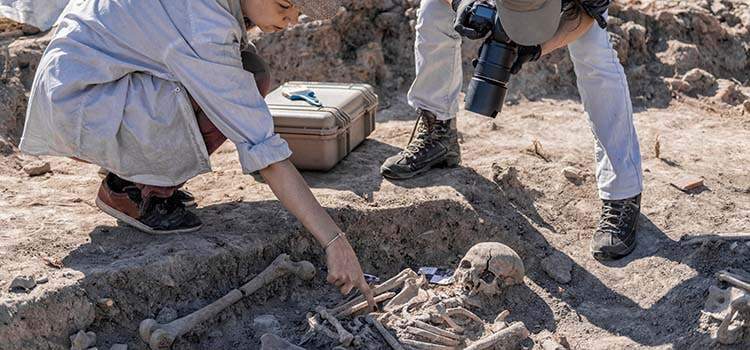
- Excavation
- Examining teeth and bones
- Studying rate of decomposition and insect development cycles
- Measuring odor and testing body leakage in the soil
- Creating a biological profile and trauma analysis
- Documenting findings with photographs and note-taking
Studying the rate of decay helps forensic scientists determine when a person died. At the Body Farm, students intentionally leave corpses out in the elements to study what happens as the body decomposes.
The goal is always the same: to simulate crime scenes so that students can document decay and learn to identify future victims (or the time and circumstances of their death). With so many forces influencing the decomposition of the human body, it is sometimes difficult—if not impossible—to determine time of death or identity. And that’s why continued forensic research is so important.
Though it is a valuable piece of forensic and criminal investigation, the work that occurs at the Body Farm does not overlap with crime scene investigation tasks such as trace evidence recovery, DNA testing or ballistic analysis.
How can I study at a body farm?
You must be a student at the university to participate in studies at the Body Farm, specifically a student in the biological anthropology department, where forensic anthropology courses are concentrated. There are undergraduate and postgraduate studies available to forensic science students and anthropology majors. The Body Farm is committed to providing training to students, federal agencies and the public, but does not offer tours of the facilities.
Who can study at the body farm outside of students?
The University of Tennessee facility offers short courses for the general public who are over 18 years of age that focus on recovery methods, field methods and human osteology. They also host federal agencies, who participate in focused training to help them better do their jobs.
For example, the Body Farm hosts the FBI Evidence Recovery Team every year, and teaches them how to locate graves and how to excavate the soil layer by layer in a systematic fashion so they don’t disturb how the evidence lies.
For the facility’s 35th anniversary of the Body Donation Program, the NCIS participated in similar training to advance their knowledge of forensic pathology and CSI work.
What can I do with a forensic anthropology degree?
Some forensic anthropologists are employed in forensic science facilities where they work closely with medical examiners or forensic pathologists. The majority of graduates work in research and are employed at colleges and forensic facilities. Many teach and work in research based in other areas of forensic science, such as pathology, odontology and criminalistics.