
By: Kendall Upton

Updated: January 14, 2026

By: Kendall Upton
Updated: January 14, 2026
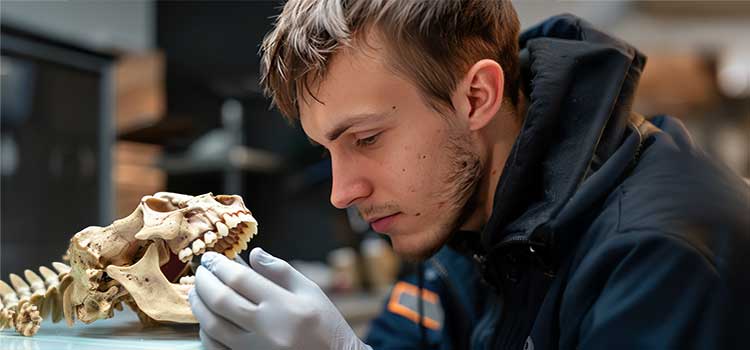
When talking about the field of forensic science, it’s generally implied that the investigations in question are dealing with human crimes and human biological evidence. But what about animal crimes, or human crimes in which animal DNA is involved? This field is known as wildlife forensic science. The professionals that specialize in the analysis of animal DNA are called wildlife forensic geneticists.
Though there are parallels, the types of professionals in this field aren’t quite as cut-and-dried as they are in human forensics. With very few academic programs in this area to boot, it can be tricky understanding how to become a wildlife forensic geneticist. But with the right combination of education and experience, it’s not impossible.
In this Article
Wildlife forensic science is the study of non-human biological evidence for the sake of or relating to legal cases and criminal investigations. It’s a broad field that encompasses both domestic animals (dogs, cats, horses, cattle, etc.) and wildlife.
So how and why might animal DNA be relevant to criminal investigations at all?
Studying non-human animal biological evidence can help solve crimes where:
Animals are the victim of animal cruelty or theft, or the remains of a lost pet need to be identified
Animals are the perpetrator and have attacked someone or another animal, have caused an accident or have caused property damage
Animals are the witness to human crimes and their DNA was transferred to the suspect, victim or crime scene
Wildlife forensic science is an umbrella term that includes many different forensic disciplines as they relate to animal cases. Wildlife forensic genetics (and the geneticists who specialize in this area) is a subcategory of wildlife forensic science that focuses specifically on DNA analysis.
“Wildlife forensic science can refer to someone who does necropsies (the animal version of an autopsy) that are used to answer legal questions, someone who specializes in forensic investigation on animal crime scenes (usually cruelty or dog fighting), or someone who is highly trained in morphology and identifies species in cases of poaching and illegal [animal] trade,” said Christina Lindquist, Senior Forensic Analyst and Quality Manager at the Veterinary Genetics Laboratory, part of the School of Veterinary Medicine at the University of California, Davis. “Where wildlife forensic genetics is the ‘DNA’ discipline in a traditional crime lab, wildlife forensic science is shorthand for talking about all the forensic science disciplines applied to animals (including DNA).”
Just like there are DNA experts for both human and non-human species, Lindquist said there are many other positions in the wildlife forensics field that are similar to ones found in the human forensics field.
“There are equivalencies of medical examiners except for non-human species, and there are equivalencies of DNA experts for non-human species. Toxicology pretty much stays the same since it doesn’t really matter which species [they’re studying], so there are toxicologists who give advice in wildlife forensic style cases. There are ballistics people who can apply their [expertise] to wildlife forensic cases. But when you get to crime scene investigation, those are very different between human forensic science and wildlife forensic science.”
Lindquist, who has experience working in human crime labs, said that the actual work performed by wildlife forensic geneticists can be quite different.
“From my experience, when you work in a human DNA crime lab you have a nice toolbox of genetic tools. You have nice standard operating procedures (SOPs) that tell you which tools to use and then you report it. It’s all very nicely delineated, and the genetic tools available to you are provided by companies. They’re commercially available DNA kits and things like that. But one of the things with wildlife genetics is that there are no kits,” Lindquist said. “We had to build those [DNA] panels, and that’s been true of the wildlife and companion animal genetics field from the beginning. There just isn’t enough demand for companies to care.”
The field of wildlife forensic science is actively evolving and working towards improving standardized DNA information, universal quality standards and capacity building.
“I think the direction that it’s going is kind of similar to when human forensics started off, they eventually realized they needed a core panel of markers that everybody in the world could get behind in order to be able to compare DNA profiles between labs, so they came up with the Combined DNA Index System (CODIS),” Lindquist said. “It’s a slow process in wildlife forensics because of the fact that there are only a couple people in the world who do genetics in a particular species. And so the movement in wildlife forensics is to kind of provide standardization where standardization is useful.”
Their most recent success, Lindquist said, was for North American deer species. Geneticists in the field realized that enough of the wildlife forensics laboratories in the U.S. work with deer to make it worthwhile to create a DNA panel.
“They all pooled all the different markers that they use to identify deer, their statistics and sample data and ran them all on the new panel. So now we have the OdoPlex, because deer are in a genus called Odocoileus, and they built their panel specifically for forensic applications, very much like our dog panel.”
Lindquist suspects that there will be efforts in the field to create a DNA panel for bears next because of the number of labs that work with bears in the United States. Internationally, geneticists may work to create a DNA panel for pangolins since they are currently one of the most trafficked animals in the world. Standardized DNA panels for more species are necessary, and when you consider just how many animal species are out there, there’s practically an infinite amount of work that can be done in this area.
There’s another major push in the field for more wildlife forensic laboratories worldwide, and to bolster the funding and resources for the ones that already exist.
“The main focus for us in terms of progressing the field is actually in capacity building in source countries. One of the pushes is for, say, instead of all the samples from the illegal pangolin trade getting sent to Ashland, Oregon, even if they’re from Malaysia, then let’s make a lab in Malaysia to test those. Let’s provide that to the source country. Let’s put some resources into the labs in Africa so that they can do the elephant genetics, not somebody in Seattle.”
Wildlife forensics is still a fairly nascent discipline, so there are very few degree programs that directly prepare you for a career in the field. Still, you need a graduate degree of some kind to do this kind of advanced scientific work. A bachelor’s degree in forensic science, animal science, biology, molecular biology, biochemistry, zoology or something similar would be applicable to this career path before moving on to your graduate education.
From there, Lindquist said there are two main educational pathways people take to get into the field of wildlife forensic science. The first is to earn a master’s degree in forensic science and focus your research efforts on animal forensics. In this path, you essentially enter the field by studying human forensics first, often in a crime lab, and then transitioning to the wildlife realm.
The second option is to go into a genetic Doctor of Philosophy (PhD) program. There you can also focus your research on animal genetics, but you get less of the forensic trading that you would expect from a forensic science program.
The choice you make could impact the types of jobs you qualify for and inform the direction of your career path.
“Places like the National Fish and Wildlife Forensics Laboratory are much more likely to hire a PhD geneticist than they are someone with a master’s degree in forensics. But then when you look at other areas and other laboratories—for example, there’s a state lab in Wyoming that deals with a lot of the hunting regulations—they might be more likely to hire on somebody trained in forensics because they only deal with a couple species, they’ve got their deer, bear and their elk. They can teach those couple of species to a forensic person much easier than a lab like the National Fish and Wildlife Forensics Laboratory where they’re dealing with every animal on the planet in terms of international trade,” Lindquist said. “So it’s a diverse field, and those two pathways seem to be the two ways people get into it.”
If the international wildlife trade interests you most, Lindquist said that a PhD is probably your best bet.
“That’s the reality that needs to be communicated. You really have to differentiate yourself in a PhD kind of way if you want to get in the wildlife trade side of it.”
As you might expect, wildlife forensic geneticists typically work in forensic laboratories. However, there are many different types of labs you can work for which affect the kind of work you may do.
“For geneticists, there’s kind of two thought patterns similar to human genetics where you would become a bench scientist and do the bench work, or you would become an analyst and do the computer analysis,” Lindquist said. “We do that in our lab, where we have somebody who specializes in the bench work, and then some of us who have done that now specialize in data analysis and report writing.”
Regardless of their specialty, wildlife forensic geneticists could work in:
Beyond the niche of genetics alone are many other roles within the realm of wildlife forensic science that may interest you:
If you’re wondering if you have what it takes to become a wildlife forensic geneticist, there’s one major quality that may seem like a positive indicator for this field but should actually be considered with caution.
“I think some people come into the wildlife forensic field because they’re passionate about animals, and I think that’s dangerous. We’re forensic scientists, and so we need to be detached. Just because you care about animals is not a good reason to come into this field. You’re going to get all of this really awful information, but you need to stay true to the science.”
Lindquist said that if you work in an animal crime lab, for example, you’re going to be exposed to a lot of animal cruelty cases. But if you’re overwhelmed with a fervent need to see the perpetrator brought to justice, it can actually cause serious problems in your career. “You don’t want to be on the stand with that kind of passion,” she said.
Many people also come into the field wanting to apply their expertise to wildlife preservation and conservation, and while that is a major objective of the work performed by wildlife geneticists, it probably shouldn’t be anyone’s sole motivating factor.
“It’s just really hard if you have that passion to distance yourself in the way that you have to distance yourself, because then that bias sneaks in. But if you love genetics and you want to keep having that as part of your career, and not so much applying genetic tools to a particular well-defined question, then this is a great field to go into.”
In fact, Lindquist said that there are training courses for wildlife forensic scientists that specifically discourage them from joining or donating to advocacy groups because if you are testifying in court, they can use that information against you to try to undermine your work.
The U.S. Bureau of Labor Statistics (BLS) doesn’t have salary data for wildlife forensic geneticists specifically. They do, however, keep track of salaries for forensic science technicians, which would probably be the closest job category, though the BLS also cites median salaries for fish and game wardens. Forensic science techs earned a median annual salary of $67,440, according to the 2024 Occupational Employment and Wage Statistics from the BLS, while fish and game wardens earned $68,180. Keep in mind that this is only an estimate, as factors like location, experience, level of education and more can all affect an individual’s earning potential.
If you want to find out more about the field of wildlife forensic genetics and wildlife forensic science at large, consider checking out some of these leading organizations within the field.
Since it was founded in 2009, the Society for Wildlife Forensic Science (SWFS) is an international membership organization whose mission has been to advance the wildlife forensic science discipline. They also offer a certification for wildlife forensic scientists.
The American Academy of Forensic Sciences (AAFS) is an extensive global network of forensic science professionals across numerous forensic disciplines, including wildlife forensic professionals. They have also published various documents on wildlife forensic standards.
The African Wildlife Forensics Network (AWFN) was launched in Botswana in 2016 with the mission to “develop and facilitate an active network of wildlife forensics stakeholders, and support access to forensic science and crime scene services across the African continent.” It is part of an initiative led by the United Nations Office on Drugs and Crime and TRACE.
Located in Ashland, Oregon, the Clark R. Bavin National Fish and Wildlife Forensics Laboratory is the only laboratory in the world devoted entirely to wildlife law enforcement. Not only do they support law enforcement efforts in all 50 states, but they also support approximately 150 foreign countries who have signed the United Nation’s Convention on International Trade in Endangered Species (CITES) Treaty.
The Organization of Scientific Area Committees for Forensic Science (OSAC), which was established in collaboration with the National Institute of Standards and Technology (NIST), has a Wildlife Forensic Biology Subcommittee that has published a registry of wildlife forensic standards.
TRACE wildlife forensics network is a nonprofit organization that seeks to help law enforcement and wildlife conservation by disseminating forensic tools and resources to combat wildlife crime.
Though they’re not the ones conducting criminal investigations themselves, wildlife forensic geneticists play an important role in the investigations of animal crimes, from dog-fighting rings to poaching and everything in between. On top of that, the field of animal genetics has incredible potential for exploration that human geneticists don’t quite have.
“I think there’s a tendency in human labs to not get to play with DNA, not get to design primers and understand the way mitochondrial DNA is packaged as a structural variant that might affect the phenotypic traits and things like that. And you could do that in the wildlife realm,” Lindquist said.
There is no singular pathway to get into this field, but any career in wildlife forensics should at least begin with a bachelor’s degree in the forensic sciences or something similar before eventually moving on to a graduate program, of which there are several options students can take. Click our Find Schools button to start your search for the program that’s right for you.