
By: Paige Cerulli

Updated: January 7, 2026

By: Paige Cerulli
Updated: January 7, 2026
As an air traffic controller, you will help to ensure that arriving, departing and maneuvering planes stay safe.

If you have a great memory, fantastic attention to detail and can stay calm in stressful situations, you have several key traits essential to a career as an air traffic controller. As an air traffic controller, you will help to ensure that arriving, departing and maneuvering planes stay safe. You’ll be part of a close-knit team working behind the scenes to keep airports and airspace safe and running smoothly, and that can be a highly rewarding career.
In this article
Air traffic controllers are integral to the aviation industry, and they can earn salaries averaging more than $100,000 per year, according to the U.S. Bureau of Labor Statistics (BLS). But many air traffic controllers find the career’s challenges engaging and satisfying.
Jake O’Neil spent nearly 15 years with the FAA as an En Route controller before founding Magical Memories Worldwide, a travel agency. “I was the kid whose mom would take me to the airport instead of the park when I was young,” says O’Neil. “I loved being around airplanes.” He notes that while the career can be stressful and intense, the job itself can be fun. “It’s an absolutely wonderful career,” he says.
Those who are best-prepared to become an air traffic controller are those who are detail-oriented and ready to put in plenty of hard work. The training process is rigorous, and O’Neil explains that trainees will need to spend plenty of time studying and learning the industry rules and regulations. To be successful, air traffic controllers must also be able to remain calm and focused under pressure.
Complete an Air Traffic Collegiate Training Initiative program.
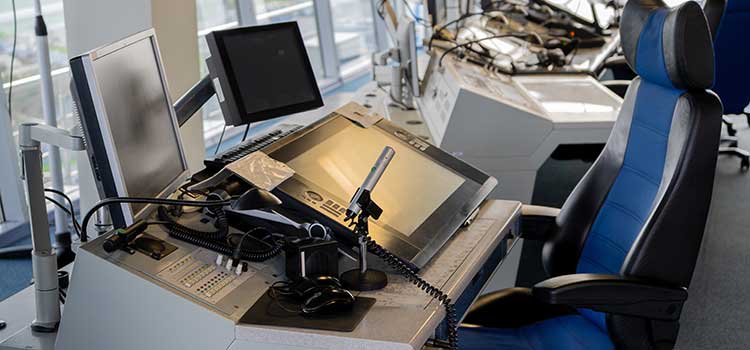
Many candidates start their careers by completing an air traffic control degree program. An Air Traffic Collegiate Training Initiative (AT-CTI) program is available as a two- or four-year program. These programs provide training and education to prepare students to apply to the Federal Aviation Administration (FAA) and successfully complete the FAA Academy.
Since students only have one chance to attend the FAA Academy and won’t be allowed to return if they fail out, completing a degree program in air traffic control can help to increase their chances of successfully completing the Academy.
Meet the Federal Aviation Administration (FAA) minimum trainee requirements.
Air traffic control trainees must meet several FAA requirements:
• Be a U.S. citizen
• Be age 30 or under on the application period closing date
• Pass a medical examination and a security investigation
• Pass the FAA air traffic pre-employment test
• Speak English clearly enough so that they can be understood over communication equipment
Applicants must also have certain experience or education. The FAA requires either a bachelor’s degree or three years of progressively responsible work experience. Alternatively, candidates can have a combination of post-secondary education and work experience totaling three years. Applicants must also be willing to relocate to an FAA facility. O’Neil explains that trainees are assigned to FAA facilities based on their final score at the FAA Academy. “You go to the Academy not knowing where you’ll end up,” he says.
Apply during an FAA direct hire period.

The FAA hosts annual air traffic controller vacancy announcements, and they accept applications only during that direct hire period. Interested candidates must apply online during the direct hire period.
Complete the FAA Air Traffic Skills Assessment.
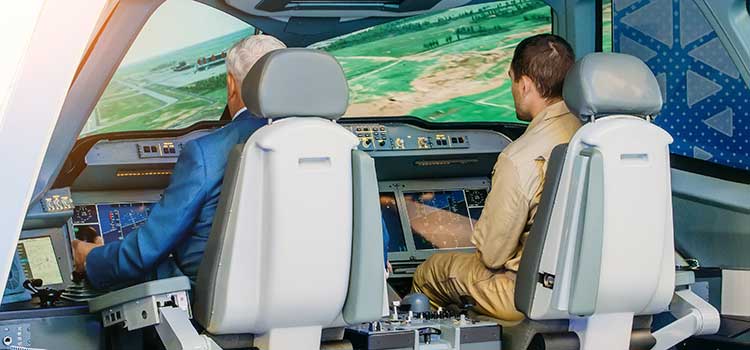
During the hiring process, applicants must successfully pass the FAA Air Traffic Skills Assessment. This is a pass/fail aptitude test consisting of seven sections. The test encompasses questions to test your memory, spatial recognition skills, reading comprehension and personality. It also incorporates an air traffic control simulation that evaluates your ability to determine which plans are going to collide, based on their flight paths.
“The exam involves things like visual processing and deductive reasoning,” says O’Neil. “They want to make sure that you can process a lot of information and make quick decisions.”
Attend the FAA Air Traffic Control Academy.

Once hired, trainees travel to the FAA Air Traffic Control Academy in Oklahoma City, Oklahoma. The Academy features intense training that can last for three to five months. Students must pass an exam at the end of the Academy before they can become air traffic controllers.
After successfully completing the Academy, new air traffic controllers will go on to complete one to three years of on-the-job training.
Air traffic controllers have high earning potential. According to the BLS, the median annual wage for air traffic controllers was $148,080. Salaries ranged from $78,420 for the lowest 10% to more than $215,610 for the highest 10% of air traffic controllers. Take a look at salaries by state:


10%$78,420
25%$104,520
50%$148,080Median
75%$190,570
90%$215,610
Median Hourly Wage$71
Job growth1.7%
Total Employment22,510
| State | Median Salary | Bottom 10% | Top 10% |
|---|---|---|---|
| Alabama | $114,960 | $79,420 | $159,640 |
| Alaska | $123,950 | $66,800 | $191,690 |
| Arizona | $136,800 | $86,630 | $195,980 |
| Arkansas | $109,760 | $76,360 | $134,430 |
| California | $160,080 | $80,960 | $225,680 |
| Colorado | $177,380 | $76,310 | $213,950 |
| Connecticut | $140,940 | $95,180 | $175,090 |
| District of Columbia | $47,760 | $47,760 | $196,310 |
| Florida | $147,530 | $86,660 | $195,960 |
| Georgia | $178,420 | $90,940 | $217,590 |
| Hawaii | $158,700 | $92,580 | $205,000 |
| Illinois | $181,560 | $83,990 | $225,680 |
| Indiana | $158,810 | $81,000 | $200,640 |
| Iowa | $90,790 | $54,930 | $121,720 |
| Kansas | $159,700 | $82,060 | $199,160 |
| Kentucky | $127,800 | $66,150 | $168,650 |
| Louisiana | $99,810 | $75,130 | $149,700 |
| Maine | $107,270 | $46,550 | $135,910 |
| Maryland | $131,290 | $96,600 | $169,920 |
| Massachusetts | $125,060 | $82,150 | $202,070 |
| Michigan | $118,930 | $80,430 | $205,380 |
| Minnesota | $176,840 | $88,940 | $218,190 |
| Mississippi | $88,110 | $64,380 | $127,170 |
| Missouri | $122,200 | $90,940 | $166,610 |
| Montana | $101,380 | $75,130 | $127,980 |
| Nebraska | $111,710 | $83,030 | $147,990 |
| Nevada | $140,920 | $80,600 | $200,160 |
| New Jersey | $132,230 | $88,460 | $209,730 |
| New Mexico | $148,550 | $77,400 | $187,790 |
| New York | $144,960 | $74,320 | $225,680 |
| North Carolina | $129,230 | $88,690 | $191,530 |
| North Dakota | $107,990 | $58,470 | $147,410 |
| Oklahoma | $123,220 | $78,340 | $169,980 |
| Pennsylvania | $132,350 | $81,490 | $225,680 |
| Rhode Island | $126,300 | $61,710 | $150,180 |
| South Carolina | $112,030 | $71,680 | $142,830 |
| Tennessee | $157,330 | $98,300 | $198,790 |
| Texas | $170,080 | $90,420 | $222,230 |
| Utah | $158,310 | $75,360 | $186,180 |
| Vermont | $109,140 | $90,500 | $139,810 |
| Virginia | $191,820 | $94,330 | $225,680 |
| Washington | $162,570 | $91,600 | $209,270 |
| Wyoming | $93,580 | $75,130 | $132,000 |
Source: U.S. Bureau of Labor Statistics (BLS) 2025 median salary; projected job growth through 2035. Actual salaries vary depending on location, level of education, years of experience, work environment, and other factors. Salaries may differ even more for those who are self-employed or work part time.
Many factors can impact an air traffic controller’s salary, including the size of the airfield where they work, whether they work full- or part-time and their years of experience.
Certain industries pay better than others, too. The Federal Executive branch has an annual mean wage of $136,040, while air traffic controllers working for scheduled air transportation earn an annual mean wage of $91,120, according to the BLS.
The Federal Aviation Administration (FAA) offers on-the-job training that air traffic controllers can complete. With completed training, controllers can potentially qualify for higher salaries.
The FAA doesn’t use the General Schedule pay system, and instead utilizes six payment plans based on job category and experience level. As air traffic controllers gain more experience, they move up payment tiers.
The BLS projects that through 2035, employment growth of air traffic controllers will be limited and should show little or no change, holding steady at around 1.7%. That equates to about 2,000 job openings that should become available each year, due to workers transferring to different careers or retiring.
It’s anticipated that the slowed employment growth is due to the increased use of the Next Generation Air Transportation System, which enables controllers to handle more air traffic, leading to decreased demand for air traffic controllers.
Air traffic controllers can earn more in certain high-paying metropolitan areas. These are the top 10 areas that pay the highest median annual wages, according to the BLS:
States employ air traffic controllers at different levels. A state’s size, number of airports, and volume of air traffic all impact air traffic controller employment. According to the BLS, these states have the highest employment rates and employ between 550 and 2,350 air traffic controllers:
Since air traffic controllers are responsible for ensuring that aircrafts stay safe during landing, takeoff and while in flight, this job carries tremendous responsibility. Air traffic controllers face frequent and often multiple challenges, but they need to be able to successfully navigate any problems that arise.
While the job itself is difficult, O’Neil explains that the training is actually the hardest part. “Training is extremely stressful, but it’s so stressful because it’s intense and there are such high standards,” he says. “Once you get through training, you’re ready for whatever comes your way.”
Air traffic controllers have different responsibilities depending on their specific role.
Tower controllers:
Terminal radar approach air traffic controllers:
En route center controllers:

O’Neil notes that air traffic controllers often spend five to six hours in the tower or in front of radar at a time. They’re required to take breaks at least every two hours to ensure that they’re not overfatigued. “Sometimes there’s a big rush or lots of military activity or special circumstances, so it can be pretty intense for the full two hours,” he says.
Air traffic controllers who work in a tower spend their time continuously looking at the whole airfield. They often use radar scopes, but also rely on binoculars and may use light guns for signaling.
In contrast, air traffic controllers working in radar rooms are focused on radar scopes or computer screens. “You have to scan all of the information around you,” says O’Neil. “There are probably seven to eight screens that you’re constantly looking at beyond the scope.”
He notes that one of the benefits to being an air traffic controller is that at the end of a shift, you’re done and there’s no paperwork to complete. He says that while there are lots of rules and regulations to follow, there is also some room for creativity. “The people who can think outside the box are often the ones who are more successful because they come up with more creative solutions,” O’Neil explains.
Successfully working as an air traffic controller requires a specific set of skills.
Air traffic controllers rely on technology to perform their work, and they will learn to use many different tools and programs:
Earning an air traffic control degree can help to prepare you for the FAA Air Traffic Controller Academy, but O’Neil explains that having a degree doesn’t guarantee that you’ll be selected for training. “Getting your foot in the door can be random,” he says.
“The FAA wants people who are willing to put in all the extra work. People who aren’t willing to put in the extra work will stand out pretty quickly to trainers and supervisors.”
Jake O’Neil
However, once you’re in the Academy, you can work to ensure you stand out from other candidates. “[The FAA] wants people who are willing to put in all the extra work,” says O’Neil. “People who weren’t willing to put in the extra work will stand out pretty quickly to trainers and supervisors.” Staying focused, studying hard and putting plenty of effort into the training process can help to prepare you for the final exam and ensure that you stand out to the trainers.
Helpful resources:
The National Air Traffic Controllers Association is a labor union and aviation safety organization that represents aviation safety professionals, provides education and hosts events.
The Air Traffic Control Association is a member-based organization that publishes industry news, hosts events and symposiums and offers an awards and scholarship program.
The International Federation of Air Traffic Controllers’ Associations publishes industry news, maintains a library of resources and hosts an annual conference and regional meetings.
Just as you would study for a college exam, you can study for the FAA Air Traffic Skills Assessment. Numerous websites offer study guides and practice tests to help you prepare to take the assessment.
The length of time that you will spend at the Academy will depend on your background and experience, as well as the type of air traffic controller that you are planning to become.
Yes, in addition to the initial physical exam required when you first apply to the FAA, air traffic controllers must take and pass annual physical exams to continue in this career.