
By: Maddie Cohen
Updated: January 7, 2026

By: Maddie Cohen
Updated: January 7, 2026
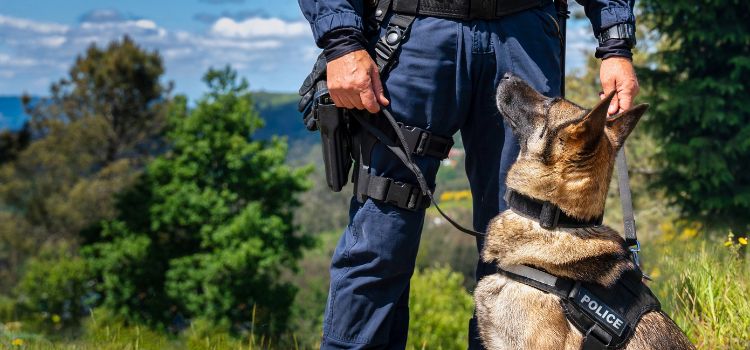
Interested in working alongside highly trained police dogs? A career as a K9 (a homophone of “canine”) officer could be the path for you. These law enforcement professionals work with their four-legged partners to perform duties that regular patrol officers simply can’t accomplish on their own.
But the path to becoming a K9 officer isn’t easy. In addition to loving dogs, you’ll need to become an elite law enforcement professional, all while taking on the responsibility of training and caring for your police dog.
In this Article
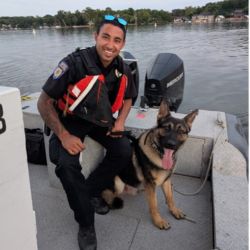
K9 officers perform all the standard duties of patrol officers, plus specialized tasks that involve their dog’s unique abilities. According to Minnesota-based Officer Brayden Sherman, who built the Orono Police Department’s K9 program from scratch, the work is both challenging and deeply rewarding.
“There’s such a small percentage of police officers that get an opportunity to be a canine handler, because most departments only have one or two dogs,” Sherman said.
K9 officers generally have duties such as:
It’s worth noting that K9 officers bear full responsibility for their dog’s care and training.
“Onyx lives with me full-time, and I’m his only handler,” Sherman said. “He sleeps at home, and I spend more time with him than I do anybody else. So, it’s a very large commitment, both professionally and personally. He’s with me all the time at home as well.”
Before you even think about becoming a K9 officer, you must first become a police officer. The educational requirements vary by department.
Here are some key considerations:
Some agencies also require candidates to be U.S. citizens, at least 21 years old and pass comprehensive background checks, drug screenings and psychological evaluations.
There are several steps you’ll need to take before you become a K9 officer.
First, you must be hired and complete training as a regular police officer. This involves earning your degree if you don’t already have one, applying to law enforcement agencies, passing all required tests and screenings and graduating from the police academy.
Nearly all departments require at least one to two years of patrol experience before you can apply to the K9 unit. Some agencies require three to five years. During this time, focus on building relationships within your department, maintaining a strong performance record and learning about police work.
Sherman was proactive. “I would go to canine classes on my off time, as an observer, to try and understand as much information as I could,” he said. “That way, when we did get a dog, I knew how to make the career and lifestyle changes I needed to make in order to be a successful handler.”
When a K9 position opens, competition can be fierce. Strengthen your application by volunteering with your department’s existing K9 unit if possible, attending canine handling workshops or courses on your own time (like Sherman), maintaining excellent physical fitness, avoiding potential disciplinary issues and building relationships with current K9 handlers to learn from their experience.
K9 handlers need to complete intensive training. Sherman and Onyx went through a three-month program starting in March 2025. “During that time he went from not even being potty trained to being able to be deployed on the streets,” Sherman said. “It was like going from kindergarten to high school.”
Training covers obedience commands and control, detection work for your dog’s specialty, tracking and trailing techniques, building searches and clearance procedures, suspect apprehension and bite work, evidence recovery, canine first aid and health care and handler safety.
Sherman emphasized that handlers are students just as much as their dogs. “Being a canine handler, it’s very in-depth, a lot more than the average eye would see,” he said. “When we went to school, I was as much of a student as Onyx.”
K9 officers work across all levels of law enforcement. They can be found in local police departments, county sheriff’s offices, state police and highway patrol. Federal agencies also employ K9 teams, including Customs and Border Protection (CBP), the Drug Enforcement Administration (DEA), the Transportation Security Administration (TSA), and the Department of Alcohol, Tobacco and Firearms (ATF).
The military also employs K9 handlers for specialized roles. These include sentry duties, scout and patrol operations, search and rescue missions, explosives detection and narcotics detection.
Dogs begin their formal police training at one to two years old and typically serve for up to 10 years before retiring. Most law enforcement K9s continue to live with their handler’s family in retirement.
According to the U.S. Bureau of Labor Statistics (BLS), police and sheriff’s patrol officers earn a median annual wage of $76,290. The lowest 10% earn less than $47,640, while the highest 10% earned more than $115,280.
K9 officers typically earn more than regular patrol officers of similar rank due to their additional training, responsibilities and expenses. Many departments provide supplemental pay for K9 handlers. For example, the California State Highway Patrol provides an additional $156 per month for K9 officers.
Several factors impact K9 officer salaries. Years of service, level of education and specialized skills or certifications all play a role. The employing agency matters too. Federal agencies typically pay more, and geographic location can make a real difference as well.
The BLS projects employment for police and detectives to grow 3.1% through 2034, roughly in line with the average for all occupations. About 62,200 openings for police and detectives are expected annually on average over the decade, mostly to replace officers who retire or leave the field.
Opportunities specifically for K9 officers are fairly limited, but not impossible to find. Some officers, like Sherman, put in the work to launch their own K9 programs.
“The most rewarding part of this work, I would say, is to think back to when you first met your canine versus where you are now,” Sherman said. “All the successes you’ve had on your deployments, and the impact a canine can have on the community, social events and helping patrol.”
The path to becoming a K9 officer isn’t easy. You’re looking at years of preparation, serious dedication and a commitment to a partnership that doesn’t end when your shift does. Your dog becomes part of your life in every sense.
But if you’ve got genuine passion for both law enforcement and working with animals, this career may offer something special. You get to serve your community while building a bond with your canine partner that most people will never experience.
So if this sounds like the career you’ve been looking for, start with your criminal justice education. Get solid patrol experience under your belt. Learn everything you can from handlers like Sherman, who are already doing the job. Then when that K9 position opens up, you may be ready to compete for one of the most rewarding specializations in law enforcement.