

By: Anna Giorgi
Updated: January 9, 2026
How to prepare for the police academy physical fitness test
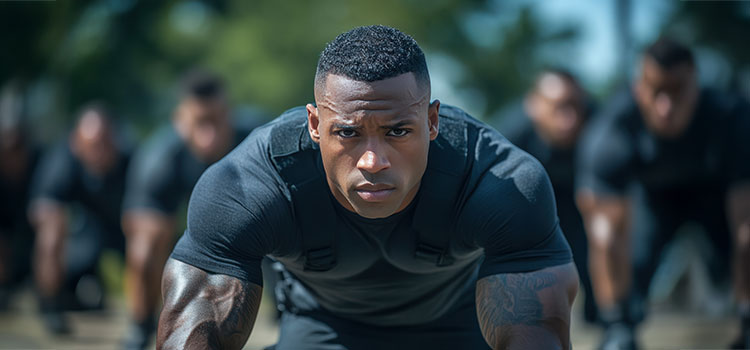
Whether you’re interested in a career as a police officer at the local, state or federal level, you will likely have to pass a demanding physical fitness test to prove that you can meet your daily duties. While the specifics of each police academy’s physical fitness test vary, most involve completing a series of structured activities within a specified time.
Passing a challenging police academy physical fitness test requires physical and mental preparation. Start by learning about the standards required in typical police academy physical fitness tests and ways you can condition yourself to succeed.
In this Article
Admission into the police academy
The process for admission into a police academy, a program that prepares newly recruited police officers for duty, is thorough and multi-faceted. In addition to a physical fitness test, candidates for most police academies typically must meet criteria in the following areas:
Most police departments provide details about these specifics on the recruitment or career sections of their webpage. This information can help you establish goals for meeting the physical fitness test, along with other qualifications necessary to apply. If you fail one portion of the test, you can usually re-apply if you don’t have a permanent disqualifier, such as criminal activity, before you retake the test.
Selected candidates attend a police academy before getting an assignment. The amount of time you spend in the police academy varies based on state and local requirements. In the U.S., the average length of basic training is 833 hours, or about five months of full-time education, according to the U.S. Department of Justice Bureau of Justice Statistics.
Elements of a police academy physical fitness test
While tests vary by jurisdiction, many U.S. police academies, such as the City of St. Petersburg (FL) Police Department, use elements of “The Cooper Standards for Law Enforcement Physical Assessment” to determine a candidate’s ability to perform essential police tasks. This set of fitness tests helps police academies evaluate a candidate’s general physical capabilities by measuring aspects of cardiovascular endurance, body strength and agility.
Cooper Standards for Law Enforcement Physical Assessment
The Cooper Standards for Law Enforcement Physical Assessment evaluates the following aspects of physical fitness:
- Dynamic strength: assessed by counting the maximum number of pushups completed in one minute
- Dynamic strength: assessed by counting the maximum number of sit-ups completed in one minute
- Cardiorespiratory fitness: assessed based on your completion of a 1.5-mile run in a specified number of minutes
- Anaerobic fitness: assessed based on your completion of a 300-meter sprint in a specified number of seconds
- Explosive power: assessed by your ability to jump vertically to a certain height
In addition to using some version of the Cooper Standards, some police academies also test fitness competence in one or more other areas that can include:
- Rowing
- Swimming
- Obstacle course
- Absolute strength (bench press)
Police academy physical test of functional fitness
Some police departments, like the New York Police Department (NYPD), use a police academy physical test of functional fitness. These tests determine whether you are fit to perform common policing tasks. To enter the NYPD police academy, candidates must complete the following actions within a set time wearing a weighted vest equivalent to a duty belt worn on the job:
Ways to prepare for success
The time and effort necessary to prepare for a police academy physical fitness test depends on your fitness levels and how far you must progress to meet the testing goals. Target testing goals, along with requirements for proper form, are typically posted on a police academy’s candidate webpage.
In a physical fitness test like the Cooper Standards, the results of each test element are categorized by gender and age group (20-29. 30-39. 40-49, 50-59 and 60+). The results are further categorized into a percentile. Some police departments assign points to each test element and require earning a specific score to pass.
According to the Cooper Standards, if you are a 20-29-year-old male and perform 40 pushups in one minute, you are in the 70th percentile for your age and gender. However, if you are a 40-49-year-old male and perform 40 pushups in one minute, you are in the 95th percentile for your age and gender. While some police academies use age/gender-based percentile requirements, others have one set of target goals that all police recruits must meet.
Train to meet and exceed the minimum requirements for each assessment based on your gender and age as defined by the police academy you hope to attend. This can help you feel confident that you will succeed on test day.
Programs to meet your fitness goals
There are many ways to prepare to meet your goals for a physical assessment. While a general exercise program can help you improve your fitness level, you should also work to pass the specific exercises you will have to pass. Start by searching the candidate webpage of your desired police academy, where you can often find programs and tips tailored to the assessments used in that jurisdiction.
If you are inactive, you may benefit from consulting a personal trainer to help you get started without injuries. You can also find many prepared exercise programs online that are tailored to passing specific types of police academy physical fitness tests.
Here is an example of a program recommended by the Philadelphia Police Department, which uses the Cooper Standards, for preparing to pass some common elements of a police academy physical fitness test:
Preparing for a sit-up test
Follow this schedule four times each week to improve the number of sit-ups you can complete in one minute:
Time your sit-ups during the fifth week to determine how many you can do in 60 seconds. Add one or two additional sit-ups to your set in each subsequent week.
How to prepare for a push-up test
With attention to proper form, follow this schedule four times per week to increase the number of push-ups you can complete in one minute:
During the fifth week, time your push-ups to determine the amount you can do in 60 seconds. After the fifth week, add a few push-ups each week to your sets.
Prepping for a 300-meter run
To prepare for a 300-meter run, complete the following sprint schedule two to three times weekly:
Week 7: Sprint 300 meters two times. Take short breaks between sprints, just long enough to catch your breath. Work to strengthen your legs on days off by using weight machines, running and/or light jogging.eek, time your push-ups to determine the amount you can do in 60 seconds. After the fifth week, add a few push-ups each week to your sets.
Getting ready for a 1.5-mile run
To prepare for a 1.5-mile run, use the following schedule to increase your running stamina and speed:
General tips for progress
While elevating your fitness levels can improve your overall health, it can also increase your risk of injuries and other dangerous conditions. To help avoid problems when preparing for a police academy physical fitness test, follow these safe exercising guidelines from Harvard Medical School:
- Consult your healthcare provider before starting a fitness program that is more strenuous than your normal routine.
- Always take five to 10 minutes to warm up and cool down.
- Start slowly and increase your activity levels gradually over time.
- Concentrate on proper form before trying to increase weight or reps.
- Take precautions to avoid overuse injuries caused by exercising too hard or too often.
- Listen to your body. Never exercise if you feel sick, fatigued, faint or experience persistent pain.
- Drink plenty of water. Choose drinks that replenish essential electrolytes when you’re exercising harder.
- Wear appropriate shoes and clothing when you exercise.
- Practice regularly. Consistency is key to improving your physical ability and performance.
To support your progress, follow a healthy diet based on recommendations from the Dietary Guidelines for Americans 2020-2025 by the U.S. Department of Agriculture (USDA). To meet these goals:
- Focus on nutrient-dense foods and beverages across all food groups.
- Include lean meats, poultry, fish, beans and eggs in your diet.
- Look for ways to enjoy plenty of vegetables, fruits, whole grains and fat-free or low-fat dairy products instead of processed foods.
- Limit added sugars, saturated fat, excess sodium and alcoholic beverages.