
By: Kendall Upton
Updated: January 14, 2026
By: Kendall Upton
Updated: January 14, 2026
Although New York may not have as many police officers statewide as places like California and Texas, New York is home to the largest municipal police department in the country: the New York City Police Department (NYPD). With over 36,000 police officers, the NYPD has about three times as many sworn police officers compared to the runner-up, which is the Chicago Police Department.
Of course, police officers in New York extend far beyond New York City. If you’re considering a law enforcement career in New York, it’s essential to understand what’s required before you can start to protect and serve your community.
In this article
To be a police officer in New York, the minimum qualifications include:
Individual agencies, such as sheriff’s officers, state troopers and police officers bureaus, often set additional standards on top of these minimum requirements. For example, the NYPD requires that police officers be at least 21 years old before they are appointed. The NYPD also requires that candidates have at least 60 college credits, though service in the U.S. Armed Forces can potentially substitute this requirement. It’s imperative, therefore, that you check with the individual law enforcement agencies you want to work for to find out exactly what they require of their police officers.
Determine eligibility.

To be a police officer in New York, you must be at least 19 years old, be a U.S. citizen, have a high school diploma or equivalent education and have a valid New York driver’s license. If you satisfy these basic requirements, start by checking the minimum qualifications for police officers at the agencies you want to work—they might (and often do) have additional requirements.
Consider getting a college degree or starting a postsecondary education.

Many law enforcement agencies require new applicants to have some college education or equivalent military experience. The NYPD, for example, requires that you have completed at least 60 college credits. If you don’t already have a degree, getting an associate or bachelor’s degree in a subject like criminal justice might be necessary depending on where you want to work.
Apply for entry-level law enforcement positions.
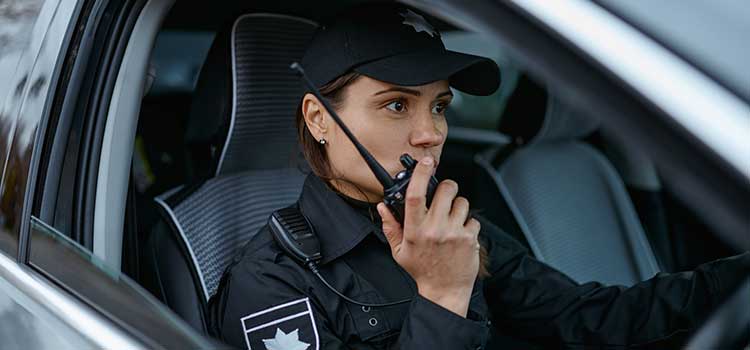
Once you’ve determined that you meet an agency’s minimum requirements for new police officers, you can start applying for positions. The application process can vary from agency to agency, but expect to undergo several evaluations including a physical fitness test, medical and psychological evaluations, a written entrance exam and a background check.
Complete basic training requirements.

Once you’ve been hired, recruits must attend a basic training program to learn and practice the skills needed to be a successful police officer. This training period typically lasts about six months. In general, you may start performing duties as a law enforcement officer once basic training is complete.
Police officers need to have, at minimum, a high school diploma or equivalent education such as a GED. Law enforcement agencies may—and often do—have more rigorous requirements on top of the bare minimum.
The NYPD requires their officers to have at least 60 college credits with a minimum cumulative GPA of 2.0. The New York State Police also has a 60-credit requirement. Both agencies may waive this requirement if you have completed at least two years of military service.
Getting an associate or bachelor’s degree, even if it’s not required for appointment, can still be an excellent career move for police officers. Not only could this make you a more appealing job candidate, but some agencies may offer pay increases for people based on their level of education. In addition, some higher-level roles as you move up the chain of command may require that you have a certain degree to qualify. All of this depends on the policies of a given agency.
Prospective or current police officers who want to earn a degree may benefit from studying subjects such as:
Before they can start patrolling the streets and combatting crime, police officers everywhere must progress through an extensive hiring process that includes training, examinations and various evaluations. The extent of these additional requirements can vary from agency to agency, but they are usually quite similar.
Once an agency determines that a police officer candidate has met their minimum requirements, the candidate must then complete the following:
After you’ve progressed through a law enforcement agency’s hiring process—including passing your background check, fitness tests and the like—it’s time to attend a basic training program through a police academy. Where you go depends on the law enforcement agency you’ve been hired at.
Some agencies like the NYPD have their own police academy, while others may send their new recruits to a regional academy utilized by multiple agencies. NYPD recruits attend the New York City Police Academy, a 32-acre campus located in College Point, Queens.
The basic training period typically lasts about six months long. In the police academy, recruits participate in a mixture of classroom instruction and scenario-based training that puts the knowledge learned in the classroom into practice, from traffic stops to crisis intervention and everything in between.
Most law enforcement agencies require police officers to complete in-service training on an annual basis. The purpose of the training is to keep officers’ skills sharp and keep them up-to-date on new laws, tactics and best practices in policing. The specifics of in-service training depend on the policies of each individual law enforcement agency.
According to the Occupational Employment and Wage Statistics from the U.S. Bureau of Labor Statistics (BLS), the median annual salary for police and sheriff’s patrol officers in New York is $93,050. Salaries in the state can vary widely, with the bottom 10% earning $53,020 and the top 10% earning $116,950.
Police officers at the NYPD may have a starting annual salary of $53,020, but that salary more than doubles after five and a half years of service. Salaries, however, do not include overtime or night shift differentials which allow officers to earn more. It may come as no surprise, therefore, that the New York City metropolitan area (which includes Newark and Jersey City, New Jersey) has the highest median annual salary in the state.
In terms of job outlook, the BLS estimates that the employment of police and sheriff’s patrol officers will grow 3.1% through 2034, which is in line with the average across all occupations. Although this growth may not be as high as other occupations, it shouldn’t be difficult for prospective police officers to find open positions. A nationwide police shortage has made many law enforcement agencies scramble to find qualified officers to fill their ranks, making it an excellent time to enter the field of law enforcement.


10%$53,020
25%$56,550
50%$93,050Median
75%$105,910
90%$116,950
Median Hourly Wage$45
Job growth3.1%
Total Employment54,360
| Metro area | Median Salary | Bottom 10% | Top 10% |
|---|---|---|---|
| New York-Newark-Jersey City, NY-NJ | $105,790 | $55,770 | $131,400 |
| Rochester, NY | $91,590 | $53,340 | $103,960 |
| Kiryas Joel-Poughkeepsie-Newburgh, NY | $88,970 | $51,180 | $110,050 |
| Elmira, NY | $84,260 | $38,660 | $96,210 |
| Watertown-Fort Drum, NY | $84,250 | $57,730 | $100,270 |
| Buffalo-Cheektowaga, NY | $80,060 | $58,080 | $100,270 |
| Binghamton, NY | $79,840 | $54,640 | $100,270 |
| Ithaca, NY | $78,130 | $59,220 | $104,890 |
| Syracuse, NY | $77,560 | $57,710 | $90,300 |
| Albany-Schenectady-Troy, NY | $77,380 | $50,320 | $101,140 |
Source: U.S. Bureau of Labor Statistics (BLS) 2024 median salary; projected job growth through 2034. Actual salaries vary depending on location, level of education, years of experience, work environment, and other factors. Salaries may differ even more for those who are self-employed or work part time.
Choosing to become a police officer is a huge undertaking. Police officers put their own safety at risk every day to protect the people in their community, but those who have the dedication, passion and integrity needed to be successful can find a fulfilling, lifelong career. In New York, the requirements to become a police officer are mostly determined by individual law enforcement agencies. Check with them first to find out what’s required and take the first step towards a law enforcement career today.
State guides for prospective police officers
Take a look at the steps you’ll need to take to become a police officer in other states: