
By: Anna Giorgi

Updated: January 8, 2026

By: Anna Giorgi
Updated: January 8, 2026
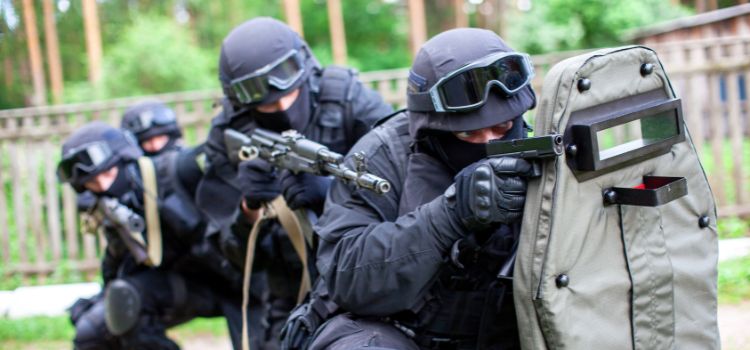
Members of Special Weapons and Tactics (SWAT) teams represent some of the most highly trained and capable professionals in law enforcement. They are known for handling high-risk operations such as hostage situations, armed standoffs and counter-terrorism missions. The path to joining a SWAT team is rigorous, in line with the critical nature of the role. While specific requirements vary by agency, the typical journey toward becoming a SWAT team officer is relatively consistent.
In this Article
A SWAT team officer is a police officer trained to handle high-risk crisis situations that require skills beyond the capacity of regular police units. The type of work a SWAT team officer does is often strategically difficult and dangerous. Their assignments may involve storming barricaded buildings, arresting dangerous suspects, rescuing hostages or de-escalating acts of civil unrest.
A SWAT team officer specializes in handling critical situations where the risk to lives—both civilian and law enforcement—is extremely high. Their skills and expertise are built on a foundation of education, experience and practice.
Due to the nature of their role, a SWAT team officer works with specialized firearms and equipment that can include heavy body armor, entry tools, ballistic shields, night vision optics and surveillance equipment. SWAT team members must maintain physical fitness, firearms qualification and current education requirements to remain ready to serve when a crisis arises.
“The reality of being a SWAT team officer is that it is a high-risk, low-use specialty in most agencies. Large police agencies, such as those near large cities, have full-time teams. More common in the United States, the SWAT team is usually a subcomponent of the agency, called a specialty team, that is used as needed,” said Captain Ryan McClain, Commander of the Hamilton County Sheriff’s Office Emergency Response Unit (Indiana) and Board member of the Indiana SWAT Officers Association (ISOA).
While every police agency has its own requirements and hiring policies, the general pathway to working as a SWAT team officer includes the following steps:
Before pursuing a position as a SWAT team officer, candidates must qualify as entry-level police officers by meeting the following criteria:
While the minimum education requirement is typically a high school diploma for many police departments, those in large metropolitan areas may require or prefer additional education or experience. Many police departments also offer preference to veterans, legacy candidates, individuals residing in their jurisdiction or those with special abilities, such as fluency in a non-English language.
“Criminal justice is always a good degree to have; however, if you’re looking at the SWAT side, any type of degree that involves a trade program would be very helpful because a lot of things we do are non-traditional in nature for law enforcement. For example, having an idea of how structures are made, or a construction background, would be helpful,” McClain said.
The requirements for post-secondary education or experience can include:
“Any type of degree could be applicable. We’re just looking to see that someone has a degree that shows they can think, make decisions and be able to work on their feet and problem-solve,” McClain said.
Before you work as a SWAT team officer, you must complete a police department application and earn an offer of employment as a police officer. During this process, you will:
Prospective police officers are typically required to complete various tests to determine their readiness to meet the daily demands of patrol. These evaluations include:
The final step of the application process often requires that you interview with a panel of command-level supervisors to determine your suitability for the position. The interview process often includes scenario-based questions designed to evaluate your judgement, professionalism, communication skills and level of preparedness to join a police department.
If you successfully complete the application process, you will be offered employment and assigned to attend the department’s police academy for new officers. This program is a rigorous experience that combines education in physical fitness, self-defense, academics and firearms instruction, covering everything from criminal justice to crisis intervention. It is an intense program designed to build practical abilities and mental toughness that will serve as a foundation for your work as a patrol officer and, eventually, a member of the SWAT team.
After graduation from the police academy, you must complete a period of field training. This involves working with another officer for about a year, where you transition from academy learning to real-world policing, guided by experienced officers. During this time, you will develop practical skills, ethical judgment and community engagement skills to prepare you to work independently.
Before you pursue employment as a SWAT team officer, you will have to demonstrate that you have achieved a level of consistent excellence in standard law enforcement duties. During this time, you should focus on:
The selection process for new SWAT team officers is competitive. Only the top candidates advance, since SWAT teams are typically small and highly selective. “Most agencies require that an applicant for the SWAT team be between a two- and five-year veteran of the agency. Then, at that point, you can join the process,” McClain said.
The requirements to join a SWAT team typically involve an application and evaluation by higher-ranked officers. Additional physical and psychological evaluations may also be necessary.
“Our team is a team. So, if you have experience, say playing sports in high school or college, we’re looking for that type of mentality. Someone who is a team player, who owns their mistakes, who is humble and adaptable. We also have the component that sometimes we have to do high-stakes things, so we want people who can make decisions, who are reliable and a very good communicator,” McClain said.
The salary you earn as a SWAT team officer can vary based on your education, professional experience, the jurisdiction in which you work and the demand for qualified applicants.
While the U.S. Bureau of Labor Statistics (BLS) does not report data specifically for SWAT team officers, they are included under the broad category of police and sheriff’s patrol officers. In this category, the median annual salary is $76,210, with the lowest 10% of officers earning $47,510, and the highest 10% earning more than $115,120.
The employment outlook for police and detectives is stable. The BLS projects job growth for this broad occupational category at 3.5% through 2035, consistent with the average projected growth rate for all U.S. occupations during that period.
The day-to-day life of a SWAT team officer can vary based on the type of department in which they work. While many large cities have full-time SWAT teams, it is not uncommon for SWAT team officers to work as full-time patrol officers, detectives or other policing roles in jurisdictions where there is not typically an ongoing need for SWAT team responses.
“We’re on call 24 hours a day, seven days a week. If a call or a situation occurs that the patrol or detective aspect needs a little bit more skills, resources and assets, they would call the SWAT team,” McClain said.
The call for SWAT team assistance can instantly change the course of the day. “For us, it can be a random Tuesday, and we can get a phone call that there’s a barricaded individual in a house from a domestic. At that point, we have to drop everything that we’re doing. We keep all our gear in our vehicles, and we have a certain amount of time that we allow ourselves to respond depending on the situation. Then, we arrive on scene, gear up and come up with a plan to deal with whatever the situation is, and this is all further influenced by the training that we do,” McClain said.
Some situations that may involve a SWAT team officer include:
“The big thing that all SWAT teams strive to be really good at, or the pinnacle call for us, is a hostage rescue. That’s where you have someone being held against their will, usually by someone who’s armed and time is against us. So, that’s our ‘Super Bowl’ of calls, if you will. There’s a lot of liability, a lot of risk and time is usually not on our side,” McClain said.
SWAT team officers also spend a significant amount of time in preparedness. This can involve:
“Our training differentiates. One call could be a barricaded individual in a house, so we’ll train structures. We’ve been getting a lot of people that have been barricading in vehicles, so we’ll train one week on vehicles, vehicle stops and vehicle takedowns. The types of calls are all very similar, but the way we approach them can all be very different, depending on the situation,” McClain said.
SWAT team officers require a wide range of knowledge, skills and talents to succeed in their roles. While each SWAT team officer may perform a special function within the team, they must work together to blend their talents to form a cohesive unit to succeed in their mission.
“For us, physical fitness is paramount. We also look at self-discipline. A lot of our team members are avid readers, constantly learning and educating themselves. We want someone who enjoys the education aspect because it’s an ever-changing beast that is the SWAT side,” McClain said.
Successful candidates for the role of a SWAT team officer also possess:
Having specific experiences can also indicate preferred personality traits. “We also look for people who are self-motivated. So, we do look for those who have gone to college for a bachelor’s, associate or trade school in higher regards at times because it shows that they can commit and they can follow a path that can lead them to the completion of a goal,” McClain said.
The role of a SWAT team officer involves performing specialized law enforcement duties that are beyond the capabilities of ordinary patrol officers. Their primary mission is to save lives by providing tactical solutions that require advanced physical, investigation and firearms skills in high-risk situations.
Working as a SWAT team officer can be attractive to individuals seeking to join an elite group that is dedicated to responding to the most dangerous and complex situations. “If you are an adrenaline seeker, it can be an exciting position with a lot of action at times. And, it’s very rewarding because when we’re called out, we know that it’s something serious or they wouldn’t be calling us. So, if everything goes as planned, it’s very rewarding to see a good outcome to a very bad situation,” McClain said.
Added benefits include more extensive and specialized education than required of patrol police officers. “As an agency, we train 16 hours a month. We get additional training and specialized equipment, so our skillset and our knowledge base on certain things are a lot more extensive than patrol,” McClain said.
Despite the chance to participate in an elite level of police work, SWAT team officers must also manage challenges inherent in the role. “The on-call schedule is pretty demanding if you have a family. Unfortunately, the liability of what we do is often very high and the stakes are very high, so there’s not much room for error, and that’s a lot of stress,” McClain said.
While responding to a SWAT team call can be a high-stakes situation, it can also require significant time spent in preparation and waiting. “The majority of our call out time is a whole lot of waiting. About 90% of the time, we’re preparing and training ready to go, while about 10% of our existence is what you see on TV. There are times when it can be tough to put in so much time and effort and not get utilized as often as you want,” McClain said.
To understand more about the unique skillset and responsibilities involved in the role of a SWAT team officer, McClain advises prospective candidates to contact a state SWAT officers association or local police department. “Most agencies do ride-along programs. So, I would encourage any interested students to reach out to their local police department and ask if they can do a ride along to get an inside view of the department, so you can see the types of calls and your community from the seat of a police car,” he said.