
By: Anna Giorgi

Updated: January 8, 2026

By: Anna Giorgi
Updated: January 8, 2026
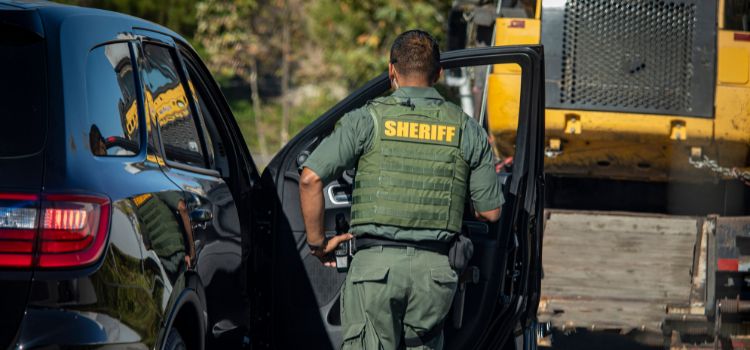
A sheriff’s deputy plays a crucial role in maintaining public safety, enforcing state and local laws and supporting the operations of a county sheriff’s department. From patrolling communities and responding to emergencies to working in county jails and serving court documents, a sheriff’s deputy fulfills a wide range of responsibilities. While the requirements and application process can vary by jurisdiction, the core steps to employment as a sheriff’s deputy are relatively consistent.
In this Article
A sheriff’s deputy is appointed or hired to assist a sheriff in carrying out a combination of patrol and administrative duties. Their authority typically extends across an entire county, encompassing both incorporated and unincorporated areas (communities that lack their own municipal government).
A sheriff’s deputy is responsible for maintaining public safety, enforcing laws and upholding the peace. They carry out duties such as patrolling, conducting investigations, responding to calls and serving warrants. They also provide security for county jails and court proceedings. In rural areas, sheriff’s deputies may serve as the primary law enforcement agency when it isn’t financially feasible for agencies to maintain local departments.
“The biggest difference in being a sheriff’s deputy is that you’re working in a more rural environment than police officers. You may still be responsible for a city or covering a city, but you’re working in a much broader area and you’re a little more on your own. For example, I might be 20 to 30 minutes from someone being in my location,” said Mike Willis, Law Enforcement National Training and Program Director for the United States Deputy Sheriff’s Association.
While a sheriff’s deputy may patrol alone, they may work in pairs for certain high-risk situations or specialized roles. In addition, they often work with other law enforcement agencies, emergency responders and community organizations to keep their community safe and secure. “When you have icy road conditions, we might be on the interstate working wrecks for hours. That’s a prime example of ways in which sheriff’s deputies work together with the state police,” Willis said.
A sheriff’s deputy may also be assigned additional duties in special assignment areas. “I encourage people to experience as many of these special areas as they can. It also helps for advancement to have diverse experience, but to also understand what you may enjoy more than others,” Willis said.
These special areas can include:
“Generally, as a rule, police departments have more specialized divisions than sheriff’s departments, but even in smaller departments, people can get specialized training in an area like accident investigation. So, there would be a person in our department that we would go to when we had to do things like re-creation of the scene or diagramming it,” Willis said. “There is a lot of opportunity to go out to specialized schools and bring that skill back and have it added to your resume.”
While the specific steps and the order in which they occur can differ by county or state, the general pathway to working as a sheriff’s deputy include:
Before pursuing related education or beginning the application process, confirm you meet the minimum requirements for a sheriff’s deputy in your county. These criteria typically include that you:
While the minimum education for a sheriff’s deputy is typically a high school diploma or GED, some departments also require one of the following:
While completing an associate or bachelor’s degree is not always necessary, it can provide a sound foundation for success in this position. Depending on the agency, your pay scale may increase with higher education levels. Consider majoring in areas such as criminal science, criminal justice or law enforcement if you decide to pursue a degree.
“Having a college degree can provide you with a background in the legal aspect of the job when coming into the position. That was one of the big gains I got from going to college. Going to the academy, I felt comfortable with a lot of that information as a result of my degree,” Willis said.
Applicants for a sheriff’s deputy typically submit completed applications to a sheriff’s department. To complete this process, you may have to provide:
The successful completion of a physical agility test is a common condition of employment for a sheriff’s deputy. These tests are mandatory to ensure that applicants can handle the physical demands of the job. Sheriff’s departments typically publicize test details, along with training tips to help you prepare.
A physical agility test may include:
Physical fitness evaluations ensure that applicants can perform at peak performance in any situation. “When you go on a shift, you never know what you’re going to be dealing with, whether it’s a medical emergency you’re helping with, or a domestic call when you have to physically take someone down. It can be so many things, and so many of them can be physically taxing,” Willis said.
Applicants who pass the physical agility test are contacted for an extensive background investigation. This typically includes a personal history statement and an investigation to verify the following aspects of your personal history:
As part of the background review, many departments also conduct polygraph examinations to ensure applicants are trustworthy.
As an applicant for a sheriff’s deputy position, you may have to pass a written examination. This typically involves a cognitive and aptitude test designed to assess the skills necessary to succeed in this role. The content focuses on basic math, English and reading, along with your abilities in human relations. Preparing with law enforcement practice tests can help you succeed.
Sheriff’s deputy applicants who pass the written examination are contacted for medical and psychological assessments. These evaluations are used to determine whether an applicant is physically and psychologically capable of performing the duties involved in this position. You can expect:
Applicants who make it to the final round of consideration typically participate in a final oral interview conducted by a panel of supervisors/command-level staff to evaluate your suitability for the position. Your communication skills, judgment, personal responsibility and level of preparedness will be evaluated.
Once selected, sheriff’s deputies typically attend a state-approved police academy. These programs typically lasts three to six months and include:
After graduation from the academy, new sheriff’s deputies typically work under a field training officer who evaluates their performance in real-world situations. This probationary phase ensures new deputies can apply their knowledge and skills safely and effectively before working independently at full-duty positions.
Individual characteristics, including your education, professional experience, the jurisdiction in which you work and the demand for qualified applicants can impact the salary you earn as a sheriff’s deputy.
While the U.S. Bureau of Labor Statistics (BLS) does not report data specifically for sheriff’s deputies, the median annual salary for the broad category of police and sheriff’s patrol officers, which includes sheriff’s deputies, is $76,210. In this category, the median annual salary for the lowest 10% of earners is $47,510, and the highest 10% earned more than $115,120.
The employment outlook for police and detectives, including sheriff’s deputies, is stable. The BLS projects job growth for this broad occupational category at 3.5% through 2035, consistent with the average projected growth rate for all U.S. occupations during that period.
There’s no such thing as a typical day in the life of a sheriff’s deputy. The duties you perform each day can vary based on the unpredictable nature of calls, which can include emergencies, disputes and transports. Factors such as road conditions or local events can also impact where your skills are most in demand.
“Working as a sheriff’s deputy is always interesting because you never know what a night is going to be like. It can involve being slammed from the second you go on for hours, and then you’re trying to catch up because you have all the paperwork elements of it as well. Or there’s other nights where you’re looking for something to do and maybe you’ll work traffic in an area that hasn’t been worked in a while or do special patrol or something like that,” Willis said.
Your daily responsibilities as a sheriff’s deputy can include:
“Working in the sheriff’s department, you may be the first on a scene at a car accident, before any other medical people, when every second counts, so I really recommend some basic medical training,” Willis said.
Sheriff’s departments seek applicants qualified to perform a variety of public safety and law enforcement services that include technical and administrative functions. These abilities and traits are representative of the knowledge, skills and/or abilities required to perform the duties of a sheriff’s deputy successfully.
In addition, some personality traits may not support success as a sheriff’s deputy. “If you’re a very methodical person who wants to analyze everything before acting, that’s not how this works,” Willis said. “Being an introvert also may not be good. You’re going to have to talk and interact with people, sometimes in a negative way and sometimes in a positive way. How you handle yourself on the scene is going to really pass over to your interaction.”
The work of a sheriff’s deputy involves police and custodial services in accordance with the mission and objectives of a sheriff’s department. These law enforcement professionals support the compliance of federal, state and local laws, typically in county-wide jurisdictions.
The opportunity to work in diverse settings with a wide range of challenges can be appealing. “Among the positives of being a sheriff’s deputy is that it’s never the same job. It’s not mundane, it’s got variety. You get to experience a lot of things. There was a lot of high-speed adrenaline, which can be very invigorating,” Willis said. “Sometimes you feel like you’re making a difference, sometimes you don’t, but you do get to touch lives in a positive way sometimes.”
While you may work independently as a sheriff’s deputy, your role also involves teamwork with other deputies as well as representatives from other law enforcement and community organizations. “When I left, I missed the people I worked with. I worked with people who care about that community, that’s why they’re doing it. No one’s doing it for the money. I definitely miss that camaraderie. You have a bond with the people you work with, which is very important.”
While working as a sheriff’s deputy can be rewarding, it may not be right for everyone. “The negatives are that it’s hard on families when you’re working evenings or nights, or not getting weekends off, or working holidays—that’s always something that you need to prepare for. It can be very demanding on your time,” Willis said. “For example, when you’re on night shift, you’re sleeping more during the day, which is also when court is held. So, you may have to get up after just two hours of sleep to go to court, so your sleep schedule can be very difficult.”
A prospective sheriff’s deputy must have the right mentality and a desire to serve. “Do it for the right reasons. Do it because you care about people and care about your community. It’s not a job you get into for the money or the glory,” Willis said. “There’s a lot of places showing bonuses to hire because they’re looking for people, and that’s fine, but you work for the public money, and you have to be realistic about it. You’ve got to have a higher purpose than simply doing it for money, especially in this job.”